Let me tell you about Tunde
I can hear someone say, “₦300,000 a night? Abeg, sign me up.”
I understand. I did the maths too. ₦300,000 multiplied by 365 nights is ₦109.5 million a year. From one three-bedroom flat in Ikoyi. The same flat a regular tenant might pay ₦25 million, ₦35 million or maybe ₦45 million a year for.
Who wouldn’t be excited?
Let me tell you about Tunde. Tunde is smart, hardworking and he has an eye for nice things. He rents a three-bedroom serviced apartment in Ikoyi for ₦35 million a year, furnishes it beautifully, takes lovely photos and lists it at ₦300,000 a night.
Tunde is sure he’s about to make serious money.
But here’s the part nobody posts on Instagram. A landlord collecting annual rent gets paid once and goes back to his life. Tunde has to find a new guest every few days. He has to keep the place clean, keep the AC cold, keep the light on, fix the tap the last guest broke and restock the toiletries.
And whether anybody checks in or not, the bills keep coming.
Even if Tunde manages to fill half the year, that ₦109.5 million dream shrinks to about ₦54.75 million. And that’s before anybody has taken their cut.
Warning! This post is not here to discourage anybody. It’s here to show you where the money actually goes. By the end, you should know whether you’d rather be the landlord, the owner running the shortlet, or the Tunde renting someone else’s apartment to run one.
₦300,000 is the price tag, not the payday
Nigeria Property Centre’s September 2026 shortlet index puts the median asking price for a three-bedroom in Ikoyi at about ₦306,400 a night. So ₦300,000 is a fair place to start.
But that’s what is advertised. It’s not always what lands in your account.
Think of it like the “last price” conversation at Balogun market. The listing says ₦350,000. Then the guest staying two weeks wants a discount. December comes and you can charge more. February is quiet and you take what you can get.
What really matters is two things: the average you actually collect per night, and how many nights you sell.
Here’s a simple one. An apartment at ₦400,000 a night that’s booked for 100 nights makes ₦40 million. An apartment at ₦300,000 that’s booked for 180 nights makes ₦54 million.
The cheaper one wins. A big price alone doesn’t make a business.
And the gap between asking and collecting is not small change. Later on, I’ll show you Tunde’s numbers at ₦300,000 a night. If he actually collects 10% less, about ₦270,000, his loss grows by nearly ₦5 million. An owner running the same flat loses the same ₦5 million off her profit.
So how often will people actually book?
This is the big question, and honestly, nobody has a perfect answer for Ikoyi three-bedrooms specifically.
AirDNA’s October 2026 data puts average shortlet occupancy across all of Lagos at about 46%. That covers everything from studios in Yaba to penthouses on the Island, so treat it as a rough guide, not gospel.
There’s also a small trick in how it’s measured. AirDNA counts against the nights an apartment was open for booking. If your place was available for 300 nights and booked for 150, that’s 50% to AirDNA. Across the full year, it’s about 41%. So once you count every day on the calendar, AirDNA’s 46% probably lands somewhere around 40% to 44%.
Why should you care? Because if you’re Tunde, your landlord wants his rent for all 365 days, not just the ones you were open.
So I’ve worked with three scenarios across the full calendar year:
- 40% occupancy: 146 nights. This is close to the Lagos average once you count the whole year.
- 50% occupancy: about 183 nights. This is my central case, and honestly, it’s already a pretty good year.
- 60% occupancy: 219 nights. This is my “things are going well” case.
These are my assumptions, not measured Ikoyi figures. Some established operators do better. But I’d want to see their booking records before I believe the hype.
Three things that will quietly eat your money
1. The rent you sign for
Rents for three-bedrooms in Ikoyi are all over the place. If you’re lucky, you might find one at ₦25 million or ₦30 million. A nicer building on a better street can easily ask ₦40 million or more.
Cheap ones are not falling from the sky. And a cheap flat with a leaking roof and a generator that coughs every evening is not a bargain.
But listen, the rent matters a lot.
Picture two operators. Same kind of apartment, same nightly rate, same number of bookings, same electricity bills. One pays ₦25 million a year. The other pays ₦45 million.
The second one starts every year ₦20 million behind, before a single guest drags a suitcase through the door. At 50% occupancy, that’s about ₦110,000 extra in rent for every night someone actually sleeps there.
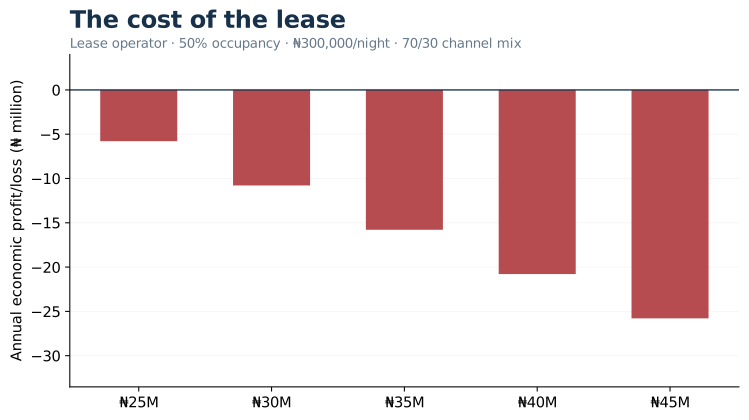
Look at that chart again. Even at ₦25 million rent, Tunde is still about ₦5.8 million in the red at 50% occupancy. Cheaper rent helps a lot, but on its own it isn’t enough.
That’s a deep hole to climb out of. Sometimes a well-negotiated lease is worth more than a fancy address or a beautiful interior.
2. Keeping the light on
This is Lagos. Your guest will forgive a lot of things. They will not forgive a hot room at 2am because light has gone.
Different buildings handle power differently. Some serviced apartments meter you while the building runs the generator. Some mix EKEDC supply with their own diesel generator. More and more places are adding solar panels, inverters and batteries.
For my main example, I assumed a serviced apartment paying ₦400 per kWh. A guest uses about 45 kWh a day, and an empty flat uses around 6 kWh. At 50% occupancy, that comes to roughly ₦3.72 million a year.
Real usage could be much higher. One guest sets the AC to 16 degrees and leaves it running while they spend the whole day at the beach. It happens.
If you run your own generator, you’re paying for EKEDC, diesel, servicing, repairs and, someday, a new generator. Work out your fuel cost from your actual machine, not a number you saw on Twitter.
Solar can cut your diesel bill. But panels, batteries and inverters cost real money and need replacing eventually. The question isn’t “does solar save fuel?” It’s “does it save enough to pay for itself?”
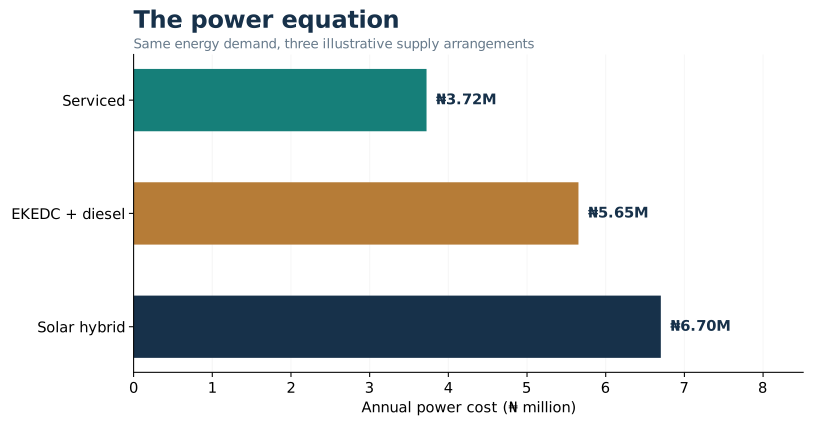
Surprised? In my example, solar comes out the most expensive. Solar does cut the grid and diesel bill, by about ₦1.4 million a year in my example. But ₦15 million of panels and batteries, spread over seven years with maintenance, costs about ₦2.4 million a year. The savings simply don’t cover the cost. Your numbers may look different, so test them.
One more thing. A serviced apartment’s service charge might already cover security, water, common-area cleaning and the generator. A non-serviced flat may have to pay for those separately. Compare the full cost of keeping guests comfortable, not just the tariff.
3. The cost of finding guests
Guests don’t just appear. Someone has to bring them, and that someone wants a cut.
Airbnb’s single-fee setup typically charges hosts around 15.5%. Other platforms and agents have their own rates.
Direct bookings through WhatsApp or your own website sound free, but they’re not. You’re still paying for adverts, payment processing, website upkeep and the time spent chasing people who say “let me get back to you.”
In my example, 70% of bookings come through platforms at 15.5%, and 30% come direct at about 4%. That works out to 12.05% of revenue. On ₦54.75 million, that’s about ₦6.6 million just to get people through the door.
If Tunde relied entirely on Airbnb, he’d pay about ₦8.5 million instead.
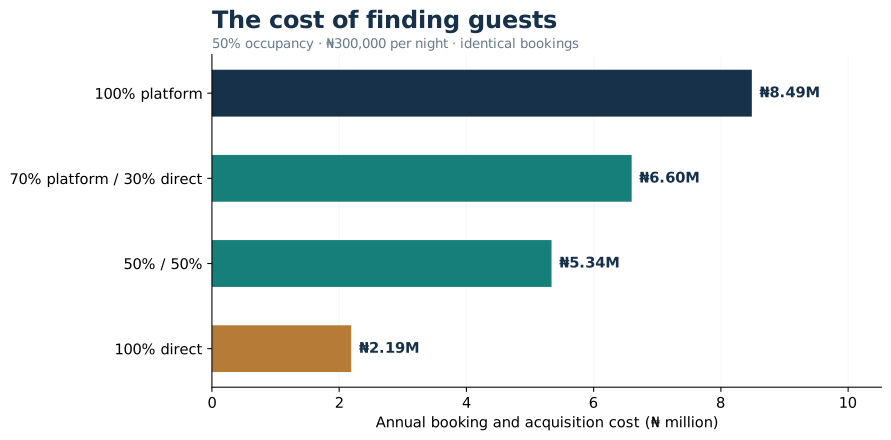
Now, before anyone deletes their Airbnb app in anger: platforms bring you visibility and travellers you’d never reach on your own. The goal isn’t to avoid commissions at all costs. It’s to get as many profitable bookings as you can.
So, how did Tunde do?
Let’s go back to our guy.
₦35 million rent. ₦300,000 a night. 50% occupancy. That’s about ₦54.75 million coming in for the year.
Sounds great, right?
After booking fees, rent, electricity and all the other running costs, Tunde ends the year with an economic loss of about ₦15.8 million.
Yup. More than ₦54 million passed through his hands and he still couldn’t cover the true cost of the business.
So where did it all go? Here’s my working for the year:
| Item | ₦ million |
|---|---|
| Money in from guests | 54.75 |
| Booking fees | −6.60 |
| Rent, plus ₦7m lease and agency fees spread over two years | −38.50 |
| Building service charge | −4.50 |
| Staff and housekeeping | −4.00 |
| Maintenance and replacements | −3.50 |
| Internet, insurance, water and other bills | −4.50 |
| Electricity | −3.72 |
| Cleaning and laundry (₦20,000 per stay, about 61 stays) | −1.22 |
| Furniture (₦20m spread over five years) | −4.00 |
| What’s left | −15.79 |
Those running costs are my own estimates, not quotes from real operators. If they come in 25% higher, Tunde’s loss grows to about ₦20.9 million. So get real quotes for your own flat.
To be fair, that figure includes a yearly share of his furniture and lease-related costs, so it’s not exactly what his bank balance will show in any one year. But it’s a warning sign all the same.
Things get better with cheaper rent, more bookings, better rates or lower costs. But the improvement has to be big enough to close a ₦15.8 million gap. That’s not a small fix.
How big a fix? Even in my “things are going well” case of 60% occupancy, Tunde is still about ₦7 million down. At ₦35 million rent, he needs about 68% occupancy just to break even. At ₦25 million rent, he needs about 57%.
And if he’s stuck at 50%, his rent would have to drop to around ₦19 million before the numbers work. That’s cheaper than anything I’d expect to find in Ikoyi for a decent three-bedroom.
Then there’s cash flow. Rent is usually paid upfront. Furniture is bought before the first guest arrives. Bookings take time to build. A business that could eventually make money can still run out of cash in its first year.
What if you own the apartment?
This is where things change.
Meet Mrs Adebayo. She owns a three-bedroom in Ikoyi. No landlord to pay. Remove that ₦35 million rent and a business that was losing money suddenly shows a profit.
In my central scenario, her shortlet makes about ₦22.7 million a year, before loans and income tax.
Not bad! But here’s the catch most people miss.
Mrs Adebayo could simply rent the flat to a regular tenant for ₦35 million a year. Take off about ₦2 million for landlord costs and she keeps around ₦33 million.
That’s roughly ₦10.3 million more than the shortlet. And with a tenant, nobody is calling her at midnight because they can’t figure out the water heater.
The income she gives up by not renting it out is called opportunity cost. It doesn’t show up as an expense in the shortlet accounts, but it’s very real.
Owning makes a shortlet easier to run profitably. It doesn’t automatically make it the best use of your property.
When does the shortlet actually win?
At ₦300,000 a night with my cost assumptions, Mrs Adebayo needs about 62% occupancy across the year just to match what a regular tenant would give her.
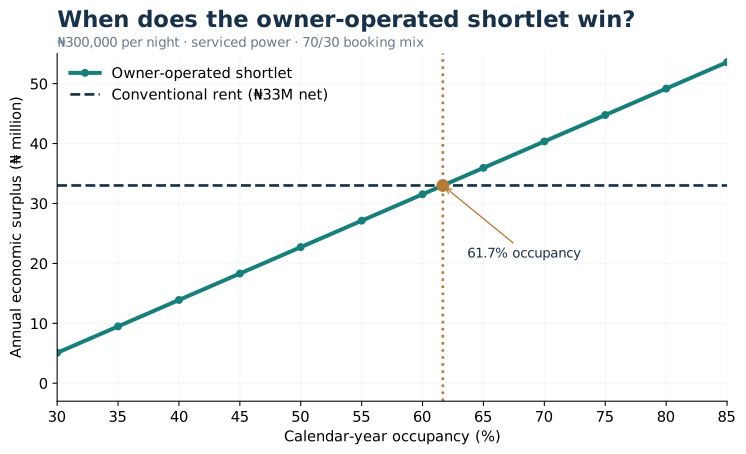
That’s well above my central 50%, which is already a good year. And if her year looks more like the Lagos average, around 42%, her surplus drops to about ₦15.7 million. That’s less than half of what the tenant would give her.
And matching isn’t really winning. If she’s going to deal with cleaners, check-ins, reviews and missing TV remotes, she’d want to earn noticeably more than the quiet tenant option. How much more is her call.
An owner with a proper hospitality setup, repeat guests and a good team might be happy with a small premium. Someone starting from scratch should want a lot more.
And don’t forget the value of the property itself, plus the money sitting in furniture and appliances. A nice yearly profit doesn’t tell you much until you know how much capital is behind it.
Let me put numbers on that. Say her flat is worth ₦650 million. In my central case, the shortlet earns her about 3.4% a year on the property and furniture combined. The tenant earns her about 5.1% on the property alone, and she gets to sleep through the night.
Three people, three different games
The landlord with a tenant gets steadier money and fewer headaches.
The owner running a shortlet keeps the rent she would have paid someone else, but she has to beat the tenant income she’s giving up.
The Tunde renting a flat to run a shortlet has the toughest job of all, because the landlord gets paid whether guests come or not.
None of them is automatically right. It depends on the property, the lease, the costs, the demand and how well the place is run.
Your guests aren’t paying for a bed. They’re paying for Ikoyi.
Here’s something the spreadsheets don’t capture. Nobody books a ₦300,000 apartment because they love your throw pillows. They book because of where it is.

That’s good news for you. The better your guests enjoy the neighbourhood, the better your reviews. Better reviews mean more bookings. And more bookings, as we’ve seen, are the difference between Tunde crying and Tunde smiling.
So do yourself a favour and help your guests fall in love with the neighbourhood. You don’t have to write the guide yourself. There’s a section in Ikoyi, Up Close: Where to Live, Where to Go, and What Nobody Tells You. It covers a few of the brunch spots, nightlife and a general feel for the area.
Drop that link in your check-in message. A guest who has a lovely evening by the water because you pointed them there will remember it when they sit down to write your review. And as we’ve seen, those reviews are what keep the calendar full.
Before you buy a single throw pillow, check the rules
In February 2026, the Banana Island Property Owners and Residents Association banned shortlet and Airbnb-style operations in the estate. So I’ve left Banana Island out of my numbers completely.
It’s a reminder for all of us. Estate rules, building policies, your lease agreement and government requirements can decide whether you’re allowed to run a shortlet at all.
The most beautiful projection in the world means nothing if the estate chairman sends you a letter in month two. Find out what’s allowed and get the right permissions before you spend a kobo.
Run your own Ikoyi shortlet numbers
Every apartment is different, so don’t just take my figures and run. Use the calculator that comes with this article. Change the rent, the occupancy, the nightly rate, the electricity setup, the running costs and the booking fees, and watch what happens.
Adjust your assumptions
Inputs are illustrative, not verified Ikoyi market averages. Rent is an annual cost for lease operators, but an alternative income opportunity for owners. Electricity tariffs, generator efficiency and solar output should be replaced with actual quotations or meter records.
Annual financial result
Compare with conventional letting
Figures are annualised economic estimates, before tax and financing. Upfront spending is not the same as annual economic cost.
You can also compare what a shortlet would earn against what a regular tenant would pay.
The point isn’t to predict exactly what your apartment will make. It’s to see where the risks are hiding before your money is on the line.
The bottom line
Can an Ikoyi shortlet make serious money? Absolutely. The demand is real and the nightly rates are real.
But high rent, quiet months, booking fees and running costs can swallow a surprising amount of that money before it reaches your pocket.
If you’re renting to run a shortlet, your lease is everything. Negotiate it like your business depends on it, because it does.
If you own the property, ask yourself one honest question. Is the extra I’d earn from a shortlet worth giving up a steady tenant, tying up more money and taking on all that work?
Some apartments will make fantastic shortlets. Others will do better with a good tenant and a quiet life.

Let the numbers tell you which one you have, not the excitement of ₦300,000 a night.
One of the biggest assumptions is that our fictional shortlet owner Tunde owns just one unit. The economics improve if he is say running a building with multiple flats who are able to share certain resources like cleaners, security etc.
Thinking about turning your Ikoyi apartment into a shortlet, or already running one? I’d love to hear how it’s going. Let’s have a conversation.
A quick note on my numbers: they’re based on a hypothetical three-bedroom apartment in Ikoyi using October 2026 market references, calendar-year occupancy and yearly running costs. They’re illustrations, not forecasts or audited results, and everything is before income tax and loan costs unless I’ve said otherwise. Remember that asking prices and what guests actually pay are not the same thing.
Sources: Nigeria Property Centre September 2026 Short-let Index; AirDNA Lagos Short-Term Rental Market, October 2026; Airbnb host fee guidance; reporting on Banana Island’s February 2026 shortlet restrictions.